
Research & development
Research for how we'll build next.
Prefabrication is the start. We look at what comes after it: machines that read drawings, data that closes the loop between model and site, materials tested to the limit, robots on the shop floor, and building systems that leave the planet.
Today’s methods built yesterday’s cities. We’re inventing the ones that build tomorrow’s.
01 · Artificial intelligence
Drawings that read themselves.
Most of the knowledge on a project is locked in drawings and specs. We are exploring how machine learning can read them, find the interfaces that will cause trouble and propose a panel layout before a person draws the first line.
Questions we're working on
- Can a model flag constructability conflicts straight from architectural sets?
- How close can an automated panelization get to an experienced detailer?
- What does a useful AI assistant look like for a shop drawing team?
02 · Data science
Closing the loop between model and site.
Every panel is measured twice: once in the model and once in the real world. We study the gap between the two, so tolerances get designed from evidence rather than habit.
Questions we're working on
- Where do dimensional deviations come from: design, shop or site?
- Which tolerance budgets are too tight, and which are too loose?
- How do scan data and production data predict install problems?
03 · Material science
Tested to the limit, layer by layer.
A panel is only as good as its layers and how they work together. We study how assemblies behave under impact, ballistic threat and heat, so high-performance envelopes are designed from test data, not assumptions.
Questions we're working on
- How do layered assemblies absorb and spread an impact?
- Which combinations stop ballistic threats at the lowest weight?
- How do conductivity, fire and durability trade off inside one panel?
04 · Robotics
From drawing to robot, without retyping.
If a panel is fully defined in data, a machine can build it. We look at how framing, fastening and handling can be automated, and at what a design has to contain for a robot to read it directly.
Questions we're working on
- Which framing operations pay back automation first?
- What data does a robotic cell need that a shop drawing doesn't carry?
- How do small shops adopt automation one cell at a time?
05 · Space
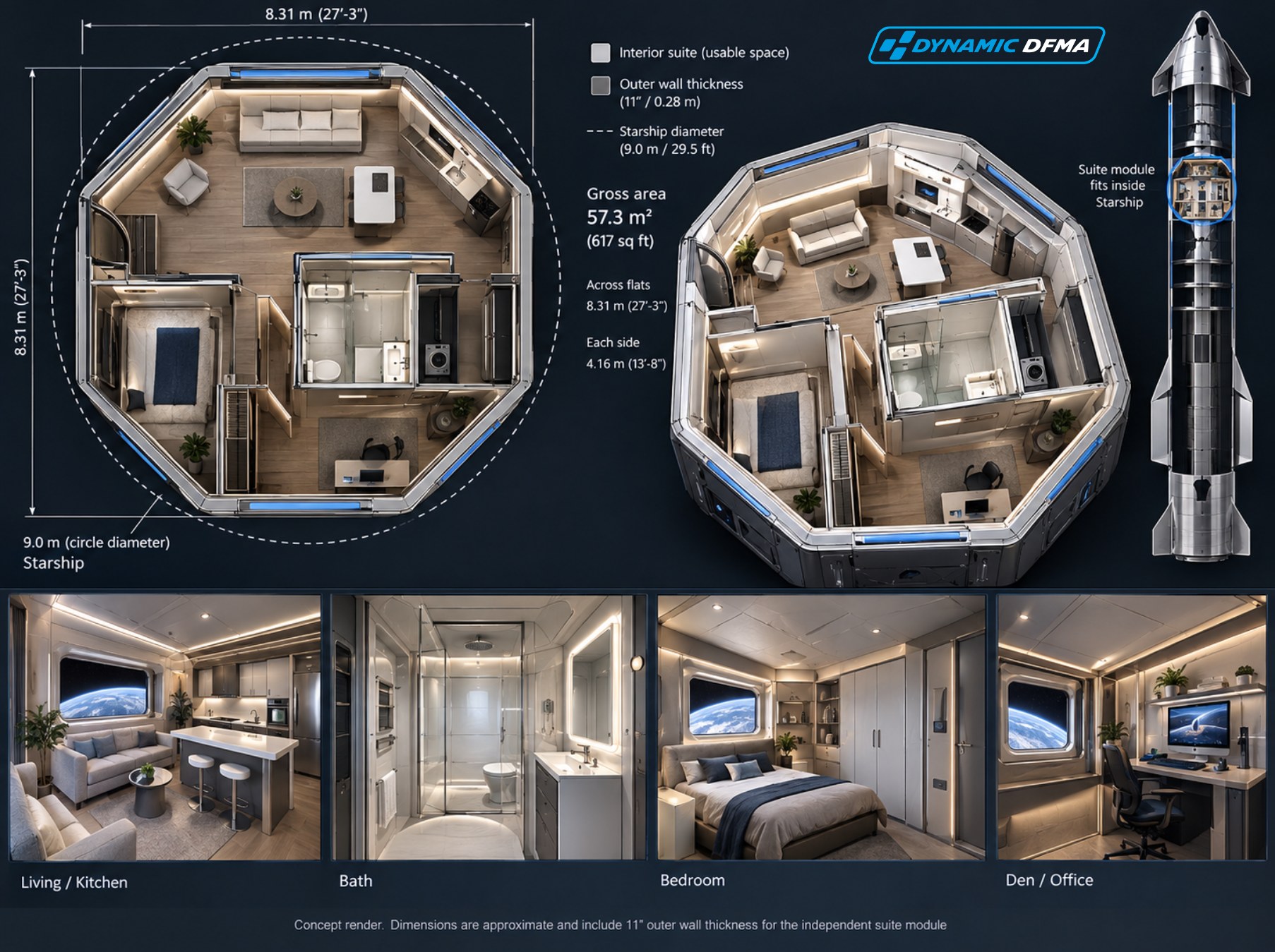
Built off-world, piece by piece.
Building on the Moon or Mars is offsite construction taken to the limit: every part made somewhere else, shipped as a kit, and assembled by few hands, or none. The same DFMA thinking we use on Earth, pushed as far as it goes.
Questions we're working on
- What can panelized building systems learn from modular spacecraft?
- How light and how few can the connections in a kit of parts become?
- Which lessons from space assembly come back to buildings on Earth?
We are so far ahead,
you’ll need a booster
to catch up.
How research reaches a project
- QuestionA problem we keep meeting on real projects.
- PrototypeA model, a script or a test piece, small and fast.
- Shop testTried with fabricators, measured, improved.
- ProjectUsed on live work, then written into our standards.
Researching something we should know about?
We work with universities, manufacturers and builders. If your question sits where design meets production, get in touch.
Talk to us about research →